Carat. Colour.
Clarity. Cut.
A century-old grading vocabulary, codified by the GIA and now used by every major lab. Four independent axes — get the trade-offs right and a stone punches well above its sticker.
Carat (ct)
One carat is exactly 200 milligrams. It measures weight, not size — a deep stone can weigh more than a shallow one of the same diameter, but face-up smaller. Carat is the most visible C: doubling the carat does not double the price, it usually triples or quadruples it because larger rough is exponentially rarer.
Colour (D – Z)
Graded by absence of colour: D is utterly colourless, Z has visible yellow or brown. Most clients can't reliably tell D from G face-up in a setting. Below H, tints become visible to the trained eye; below K, to anyone.
Clarity (FL – I3)
Inclusions and surface blemishes — graded under 10× magnification. From flawless (FL) down to obviously-included (I1–I3). For lab-grown, the inclusion profile reads slightly differently — typical features are pinpoint metallic flux marks (HPHT) or wispy graining (CVD).
Cut (Poor – Excellent)
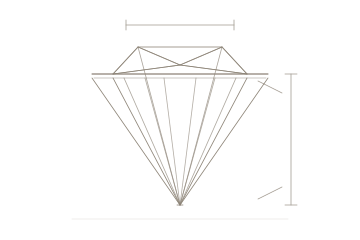
Cut is a stone's craftsmanship — the angles, proportions, and finish that decide how light bounces back to the eye. A poorly-cut D / VVS1 will look dull next to a well-cut G / VS2. The other three Cs describe what the stone is; cut decides how alive it looks.
Eight shapes,
three in stock.
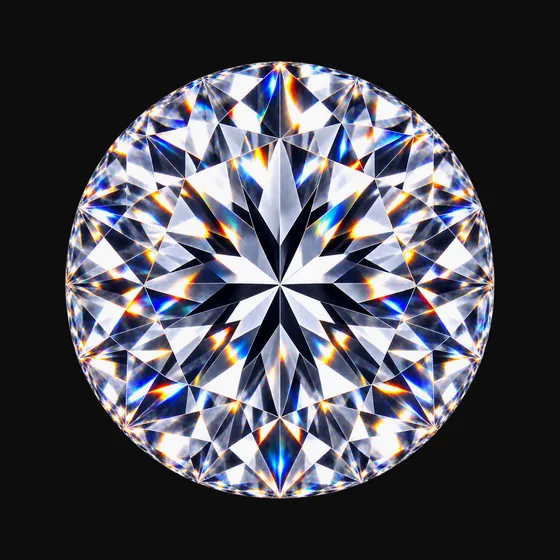
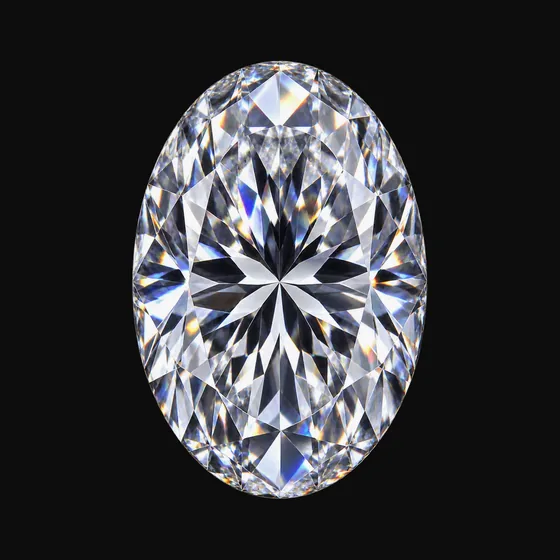
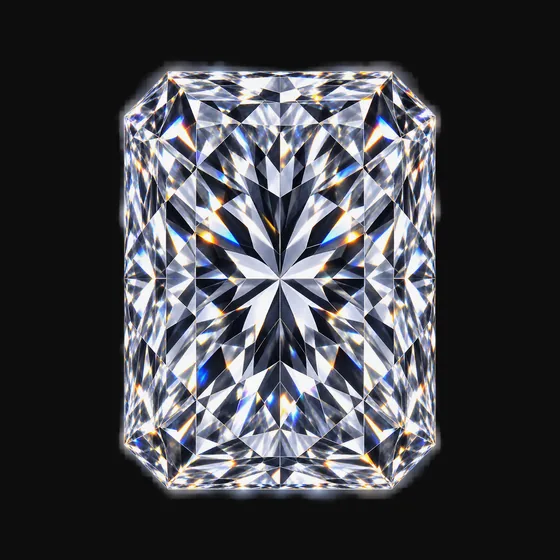
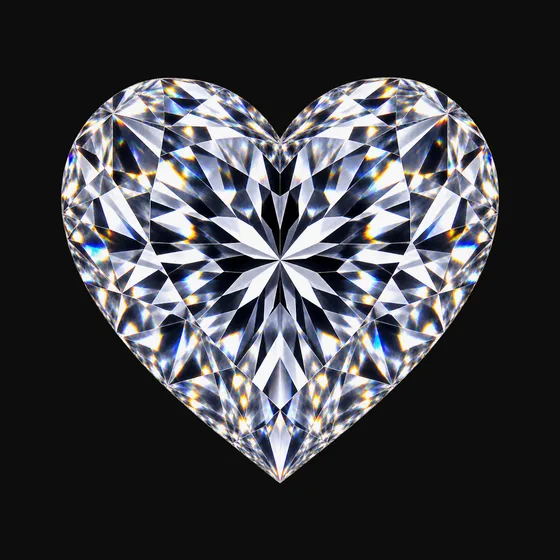
Round brilliant accounts for ~70% of trade demand and is what we keep deepest. Oval and pear we hold in working depth. Anything else we source on commission within 10 working days.
The default. 57–58 facets, the most studied light-return on earth. Any setting, any era, no surprises.
Looks larger per carat than round, lengthens the finger. Beware the bow-tie — well-cut ovals minimise it.
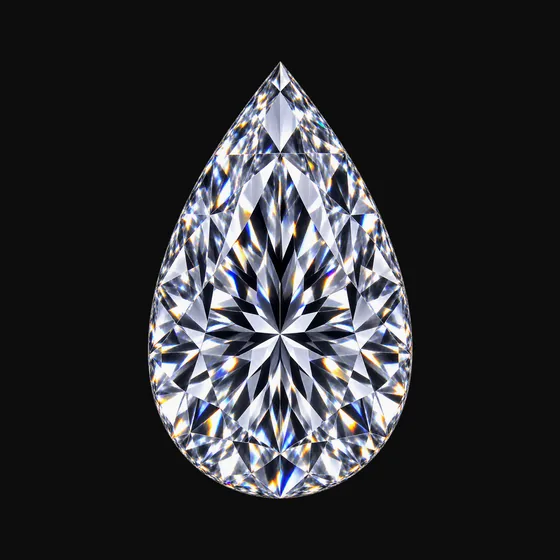
Teardrop. Modern, asymmetric, photographs well. Set point-up for elongation, point-down for boldness.
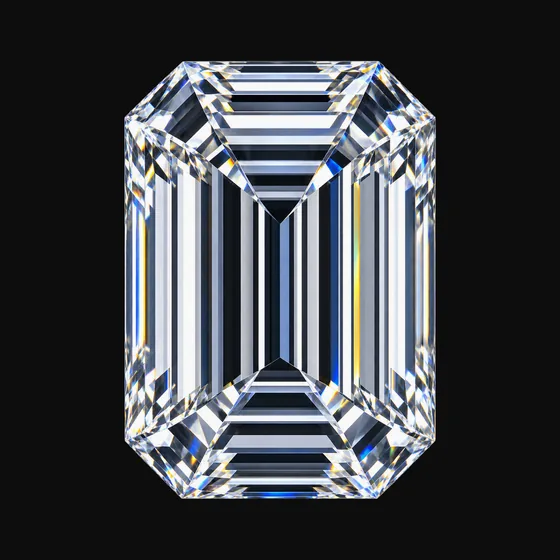
Step cut. Long parallel facets — broader flashes, a glassy, architectural look rather than fire.
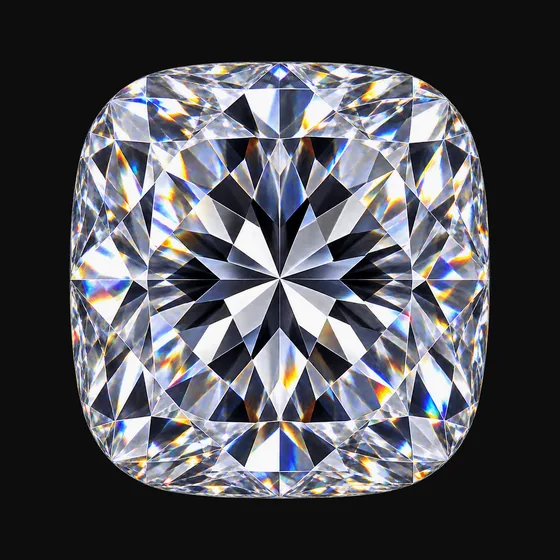
Soft-cornered square. The vintage choice — warm, candle-lit fire rather than disco brilliance.
Cropped corners, brilliant facet pattern — the rectangle that reads as bright as a round.
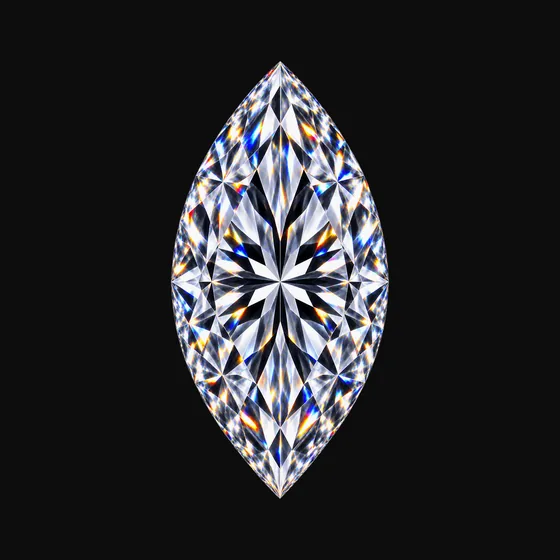
Pointed oval. Maximum face-up area per carat — looks the largest of any shape at the same weight.
Square step-cut. Hall-of-mirrors effect, distinctly Art Deco. Demands very high clarity.
Same diamond,
different birthday.
A lab-grown diamond is not a "diamond simulant" — it's a real diamond that crystallised in weeks rather than billions of years. Same carbon, same lattice, same hardness, same fire. Only the where and the when differ.
| Lab-grown — Nuriel supplies | Mined | |
|---|---|---|
| Composition | Pure carbon, sp³ lattice | Pure carbon, sp³ lattice |
| Hardness | 10 / 10 Mohs | 10 / 10 Mohs |
| Refractive index | 2.42 | 2.42 |
| Grading | Same 4Cs by IGI / GCAL / GIA | Same 4Cs by IGI / GCAL / GIA |
| Origin | Conflict-free by definition. Documented to the chamber and the day. | Variable. Kimberley Process traces country of origin, not site. |
| Carbon footprint | Roughly half of mining, when grown on renewable grids | Significant — pit, water, transport, refining |
| Trade price | 60–80% below mined at the same grade | Premium driven by scarcity narrative |
| Resale | Currently weak — secondary market is young | Established, but spread between trade and retail is wide |
Two methods.
Same result.
Modern lab-grown diamonds are made by one of two routes — chemical vapour deposition (CVD) or high-pressure high-temperature (HPHT). Both produce real, gem-quality diamond; they leave faintly different trace patterns under spectroscopy that the labs use to mark origin.
CVD
Chemical Vapour Deposition. A diamond seed sits in a vacuum chamber filled with methane and hydrogen; microwave energy strips the methane apart and carbon settles on the seed atom-by-atom, building the diamond layer-by-layer.
HPHT
High-Pressure High-Temperature. A small diamond seed sits inside a cell of carbon and metallic flux. The cell is squeezed to ~5 GPa and heated to ~1,400°C, mimicking the conditions deep in the earth's mantle. Carbon dissolves into the flux, then re-crystallises onto the seed.
A grading report,
field by field.
Every Nuriel stone ships with an IGI or GCAL report. Eleven fields you should know how to read — they tell you exactly what you bought.
IGI Laboratory Grown Diamond Report
Where to buy.
Where to save.
Across thousands of stones traded, the same answer: cut Excellent, colour D–H, clarity VS1–VS2. That window costs roughly half what its grade-card looks like, with no visible compromise. Below is the field, with the Nuriel range marked.
| Premium spend | The sweet spot — Nuriel | Avoid | |
|---|---|---|---|
| Cut | Excellent · ideal proportions | Excellent — non-negotiable | Good or below |
| Colour | D–E (colourless) | F–G (face-up identical) | I and below |
| Clarity | FL · IF · VVS1 | VS1 · VS2 (eye-clean) | SI2 and below |
| Carat | 1.50, 2.00, 3.00 (round numbers) | 0.90, 1.40, 1.90 (just under) | 0.49, 0.99 (cut to weight) |
| Fluorescence | None | None — Faint | Strong, Very Strong |
| Cert | GIA | IGI · GCAL | Unbranded labs |